
A few months ago, Cantabria económica published an article discussing whether Santander would be a good host for the America’s Cup. Even dropping in the article that the lack of infrastructure would make a hypothetical candidacy difficult, I couldn’t contain my excitement at the thought of seeing America’s Cup sailboats live in the Santander bay.
But Juan, what makes these sailboats special? Well, the 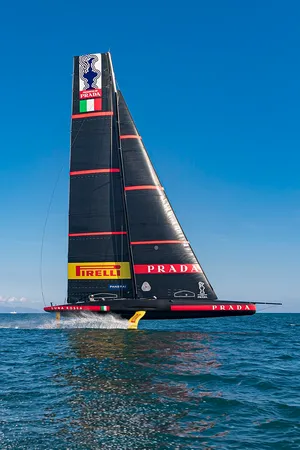
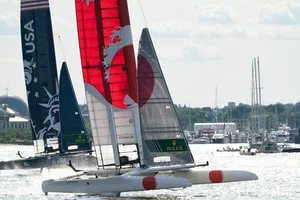
Our engine? The wind
Points of sail
One of the vital pieces of knowledge in sailing is understanding how the wind affects our boat. Let’s start with some basic nomenclature about the points of sail:
- Running: This is the point of sail we all imagine when we think of a
sailboat. The wind reaches us from the
stern Rear part of the boat
- Reaching: This is a boat’s point of sail when the wind hits it on its beam, that is, perpendicular to the direction it is heading.
- Broad reach: The intermediate course between running and reaching, that
is, we receive the wind on the boat’s
quarter Part of the boat between the beam and the stern
- Close-hauled: This is the most counterintuitive point of sail. The boat
moves against the wind, receiving it on its
bow Part of the boat between the bow and the beam
bow Front part of the boat
- In irons: In this point of sail, you cannot move forward. The wind
reaches us from the
bow Front part of the boat
windward Direction from which the wind is coming
If you have to take anything away from this article, it’s that when Jack Sparrow says “set sail Direction from which the wind is coming
But how does the boat behave on each of the points of sail? The force vector, which defines how the boat will move, can be divided into 3 components that will make our analysis easier. Taking some naming liberties, we will call them the bow component, the stern component, and the beam component:
Close Hauled: High side force (leeway) and the backward component still pushes slightly backwards. The hull (keel and shape) is vital to counteract this.
As can be seen, to produce the boat’s forward movement we need to minimize the stern and beam components as much as possible on the different points of sail so that the bow component makes the boat move forward. On points of sail like running, it is not particularly problematic, but on reaching and, especially on close-hauled, these components cause us problems as they deviate the boat too much from the desired direction.
The stern component is easy to explain how to mitigate. Simply, boats are wide at the stern and narrow towards
the bow. That is, the stern is much less hydrodynamic than the bow, generating a lot of drag to backward movement and canceling, to a large extent,
the Rear part of the boat
The keel and heeling
How do we prevent the beam component from taking the boat far away from our destination (leeway)?
The answer is the Vertical fin under the hull that prevents leeway
Slide the control to adjust the wind force and observe its effect on heeling.
But, if the keel is so small compared to the sail, how is it possible that it opposes so much resistance
to Sideways drift of the boat caused by the wind
The apparent wind problem
Having mitigated the two wind components of stern and beam, we can now conclude the fastest point of sail for the boat. As is obvious, the fastest point of sail is the one that maximizes the bow component. Therefore, we can conclude that it is when the boat is running, right?
Not quite, if we watch a SailGP race we can see that the course they take when the
next mark is to Direction towards which the wind is blowing
Why does this happen? Well, as our friend Albert Einstein would say, everything is relative. So far in our explanation, we have talked about absolute wind speed, that is, assuming the boat is stationary. However, the force exerted by the wind on the boat depends on the wind speed relative to the boat’s speed, called apparent wind.
What does this mean? That a boat moving downwind loses apparent wind since it gets weaker by subtracting the wind speed from the boat speed. And conversely, a boat that sails against the wind has an increasingly stronger apparent wind as its speed increases.
Taking this into account, we realize that depending on the absolute wind speed and
the boat speed, we are interested in taking one course or another to reach our destination.
For example, if we want to reach a point that is to Direction towards which the wind is blowing To turn the bow of the boat towards the wind
To represent these maximum speeds as a function of the wind, polar diagrams are used,
which are intrinsic to each boat model. We will use as an example measurements taken from
a 
(Credits to orc.org for data collection)
As can be seen, to get to a leeward point as soon as possible, the fastest course is not running(in fact, in the data this course is not even included because it is unstable) due to the loss of apparent wind but a broad reach.
Now, let’s look at the speed record obtained in the SailGP competition:
Quite counterintuitively, the fastest speed is achieved with a reaching wind and it coincides with the diagram data! Being more precise, the top speed is achieved after bearing away a few degrees downwind after having managed to accelerate while reaching.
Although it seems strange, after explaining how apparent wind and the components of force work, it makes perfect sense! By going totally perpendicular to the wind, we don’t lose wind as we move forward and therefore the force of the wind remains, ideally, constant, being able to achieve, in our simplified frictionless model where cows are spherical and PI=3, whatever speed we want.
The challenge? The sea
We’ve already seen how to squeeze the most energy out of the wind by playing with the points of sail and the apparent wind to generate the greatest possible force. However, unfortunately in the real world friction exists and there is a great physical wall that slows us down: the sea.
Drag
Water is approximately 800 times denser than air. No matter how much force we manage to capture in our sails, pushing a boat’s hull through such a heavy fluid generates colossal friction.
Historically, the speed of a traditional sailboat was conditioned by its “hull speed”, a hydrodynamic limit at which the boat gets trapped by the very wave train it generates as it moves.
As the boat accelerates, the wave generated by its bow becomes longer and longer.
When hull speed is reached, the length of this wave equals the
boat’s length, leaving the bow riding on the crest and the stern falling into the trough.
Physically, this slope causes an aft shift of the submerged volume and,
with it, the delay of the “center of The submerged part of a boat hull
Low speed: The boat barely generates waves. Drag is minimal and it sails flat.
Although lighter boats manage to mitigate this effect by planing (skimming over the surface of the water instead of pushing it aside), the large surface in contact with the sea still slows the boat down enormously.
So, if friction with the water is the problem… why not avoid the water?
Hydrofoil
This is where spectacular modern engineering comes into play with hydrofoils.
If you look closely at the
Their operating principle is exactly the same as that of airplane wings, but applied to a much denser fluid. As the boat accelerates pushed by the wind, the water flow passes through the asymmetrical profiles of the foils, generating a great upward lift force.
Upon reaching a certain critical speed, this lift becomes greater than the boat’s own weight, lifting the hull completely and lifting it out of the water. From one moment to the next, hydrodynamic drag drops drastically, since the only surface in contact with the sea becomes the bottom part of the foils themselves and the rudder blades.
Foiling Takeoff
As the boat accelerates, water flowing over the foil generates upward lift proportional to the square of the velocity. Once the lift vector exceeds the boat's constant weight, the hull rises from the water, drastically reducing drag.
Thanks to this massive reduction in friction, combined with the multiplying effect of the apparent wind we saw earlier, the boat is “freed”. The sailboat continues accelerating until it multiplies the real wind speed by three or four, catapulting the crew to reach the mind-boggling figure of 100 km/h (almost 55 knots) over the surface of the ocean. Pure physics working in perfect harmony!